
Radian Circle Chart
The radian circle — better known as the unit circle — links degrees, radians and the sine and cosine of every standard angle in one picture. Type any angle, in degrees or radians such as 5π/4, and the converter shows it on the circle with its reference angle, quadrant, coterminal angle and exact trig values. Print the full chart or a blank version for practice.
- Free to use
- No sign-up
- Runs in your browser
Unit circle and angle converter
Examples: 135, 135°, 3pi/4, 3π/4, -pi/6, 2.5 rad, 7π/3
Unit Circle Printables
Printable unit circle charts (full, degrees only, radians only, blank practice), an exact trig values table, and degree–radian conversion worksheets with answer keys.
- Full unit circle (PDF)
- Blank practice circle (PDF)
- Degrees only (PDF)
- Radians only (PDF)
- Exact values table (PDF/XLSX)
- Degrees → radians (PDF, DOCX)
- Radians → degrees (PDF, DOCX)
Formats: PDF, XLSX, DOCX. Instant download after payment (link valid 72 hours, up to 5 downloads). AI-assisted: the templates were drafted with AI help and reviewed and laid out before publishing.
$5.00 USD, one-time 7 files · about $0.71 each
- Instant download
- 7-day refund
- Secure checkout by Stripe
7-day money-back guarantee. Full refund within 7 days of purchase, even after you download.
Free sample: Degrees to Radians (PDF, 95 KB)
Full refund within 7 days — see the refund policy and license.
Free printables
Single sheets you can print right now, no sign-up. The full pack adds every sheet in one download plus the editable files.
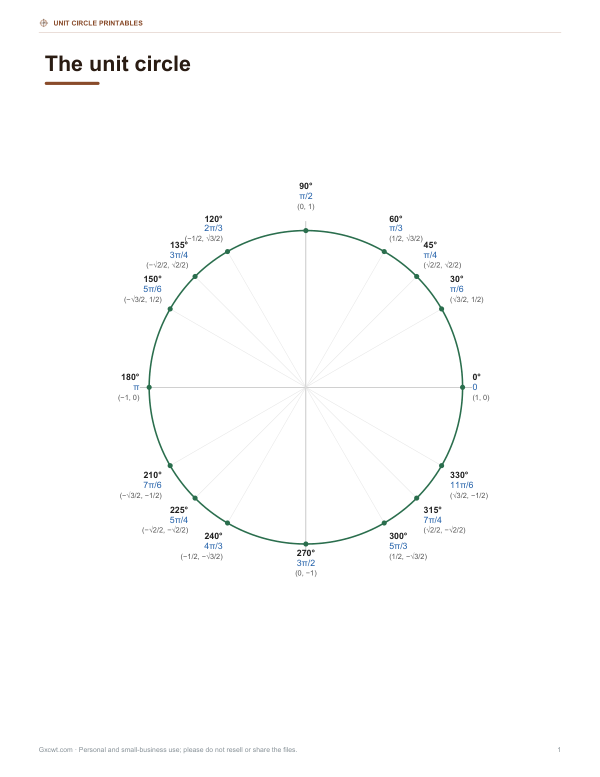 Printable Full Unit Circle Chart1 page · free PDF
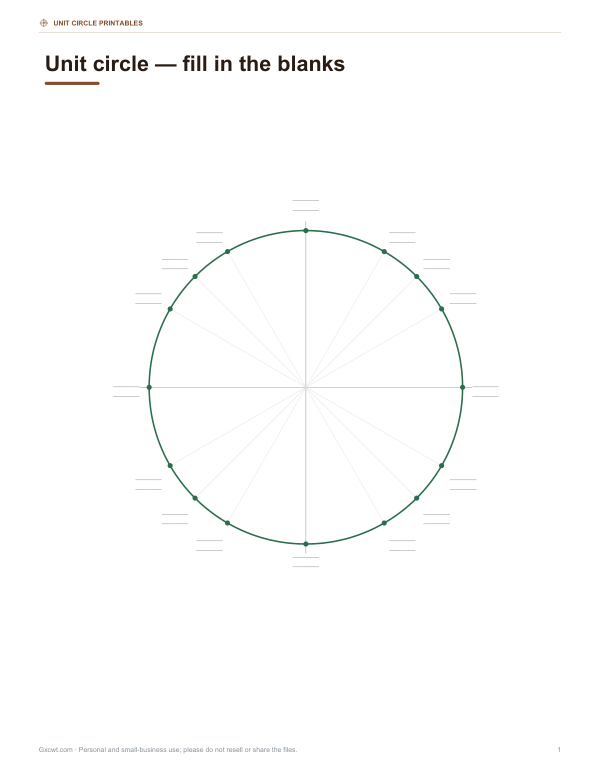 Printable Blank Unit Circle Practice Sheet1 page · free PDF
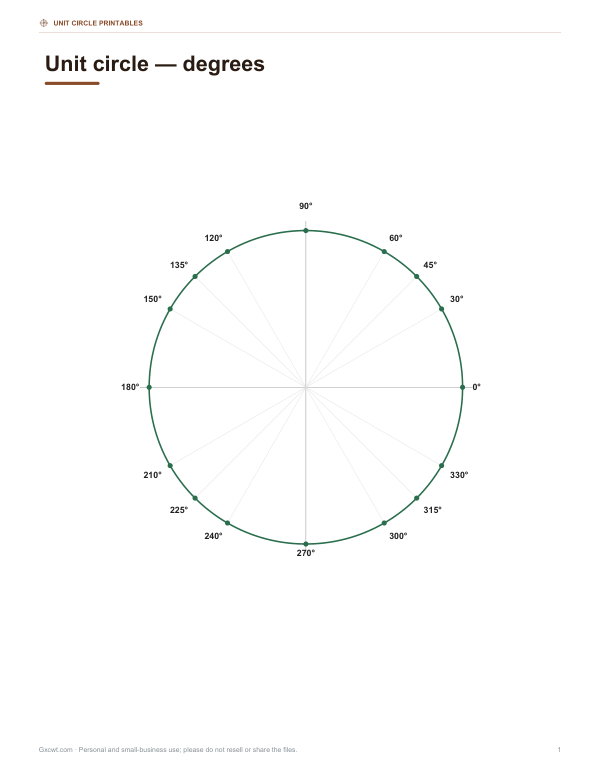 Printable Unit Circle Degrees Chart1 page · free PDF
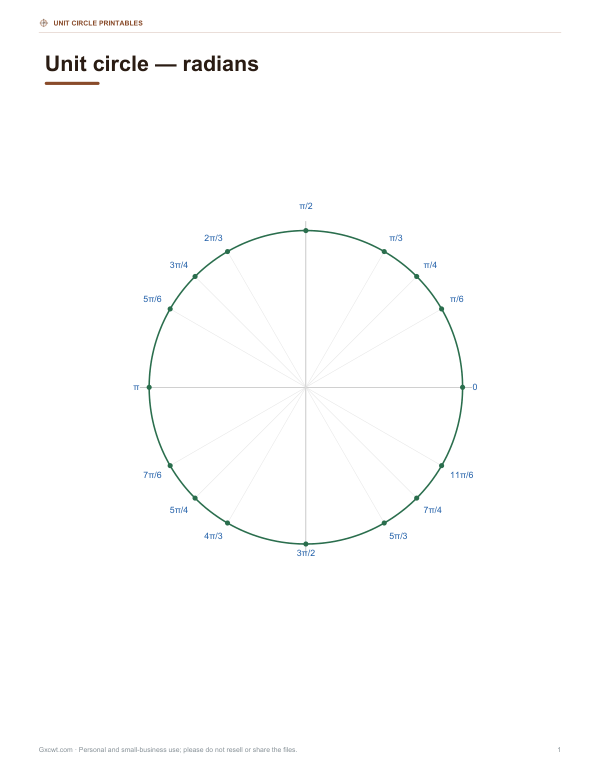 Printable Radian Circle Chart1 page · free PDF
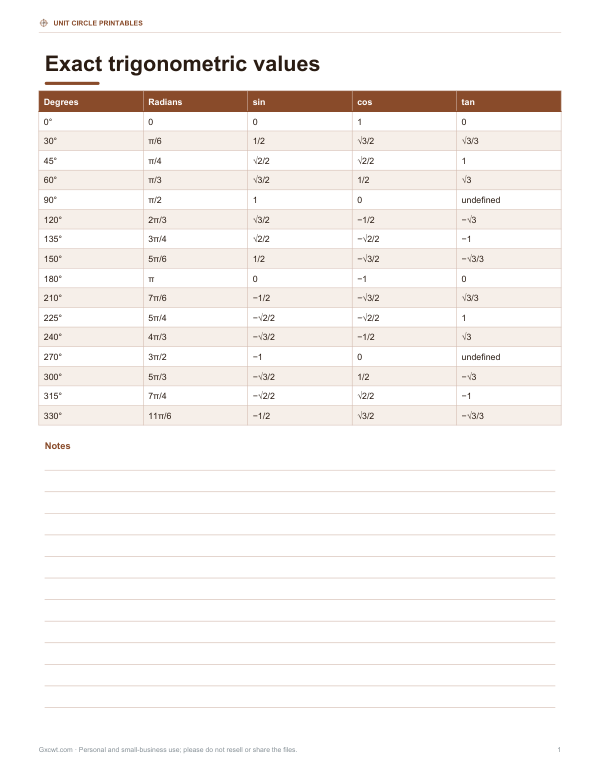 Printable Exact Unit Circle Values Table1 page · free PDF
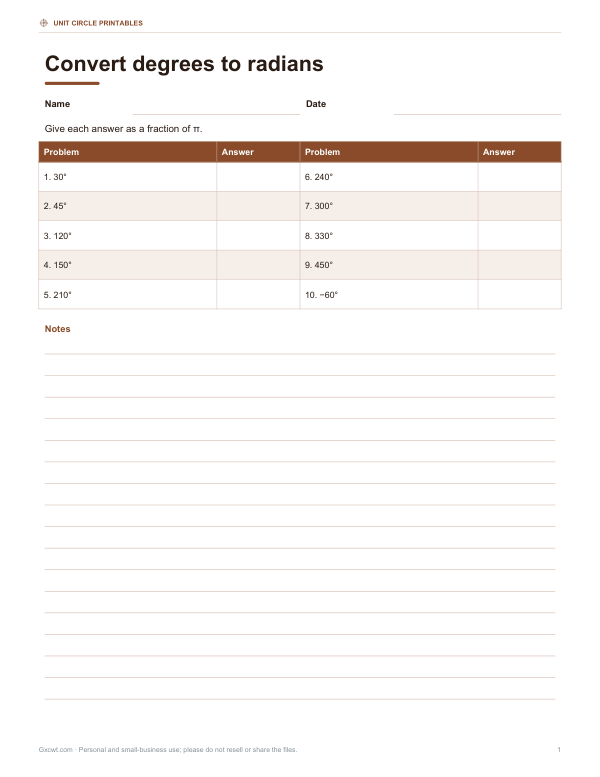 Degrees to Radians Printable Worksheet2 pages · free PDF
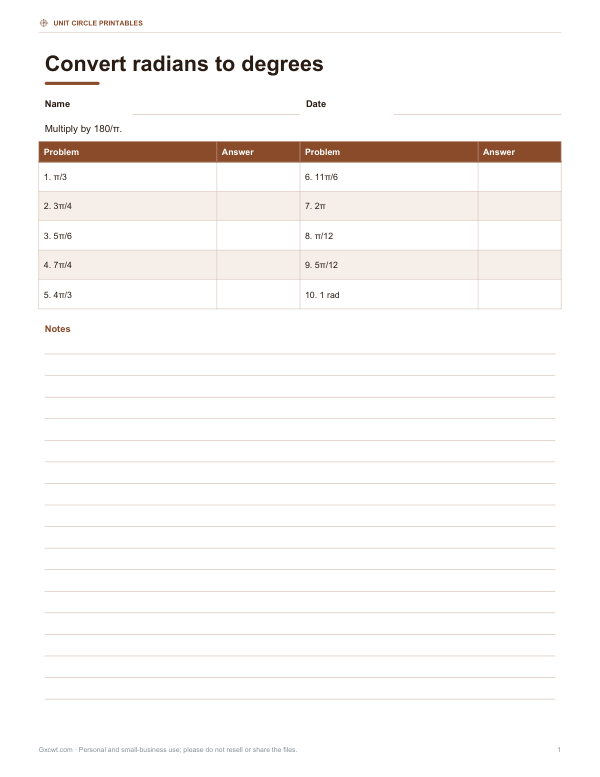 Radians to Degrees Worksheet2 pages · free PDF
What the radian circle shows
The unit circle is a circle of radius 1 centred at the origin. For any angle θ measured anticlockwise from the positive x-axis, the point where the angle’s ray meets the circle has coordinates (cos θ, sin θ). The chart marks the sixteen standard angles — multiples of 30° and 45° — with their degree measure, their radian measure as a fraction of π, and the exact coordinates. Once you understand the first quadrant, the rest follows from symmetry.
Degrees and radians
| Degrees | Radians | cos θ | sin θ | tan θ |
|---|---|---|---|---|
| 0° | 0 | 1 | 0 | 0 |
| 30° | π/6 | √3/2 | 1/2 | √3/3 |
| 45° | π/4 | √2/2 | √2/2 | 1 |
| 60° | π/3 | 1/2 | √3/2 | √3 |
| 90° | π/2 | 0 | 1 | undefined |
| 180° | π | −1 | 0 | 0 |
| 270° | 3π/2 | 0 | −1 | undefined |
| 360° | 2π | 1 | 0 | 0 |
A radian is the angle that cuts off an arc equal in length to the radius. A full turn is 2π radians, so 180° = π radians. To convert degrees to radians multiply by π/180; to convert radians to degrees multiply by 180/π.
How to use the converter
- Type an angle in any common form: 225, 225°, 5pi/4, 5π/4, -pi/3 or 3.1 rad.
- Choose whether plain numbers mean degrees or radians.
- Read the equivalent measures, the coterminal angle between 0° and 360°, the quadrant and the reference angle.
- For standard angles, exact values of cos, sin and tan are shown alongside decimals.
- The red ray shows the angle on the circle; choose a label style and print the chart.
Remembering the first quadrant
A popular trick: write the sines of 0°, 30°, 45°, 60° and 90° as √0/2, √1/2, √2/2, √3/2 and √4/2 — that is 0, 1/2, √2/2, √3/2 and 1. The cosines are the same list in reverse. Tangent is sine divided by cosine. Another memory aid is the left-hand trick: hold up your left hand with fingers for 0°, 30°, 45°, 60° and 90°; fold down a finger and count the fingers above and below, take square roots and divide by 2 for cos and sin.
Using symmetry and signs
| Quadrant | Angles | Positive functions |
|---|---|---|
| I | 0° to 90° | all (sin, cos, tan) |
| II | 90° to 180° | sin only |
| III | 180° to 270° | tan only |
| IV | 270° to 360° | cos only |
The mnemonic “All Students Take Calculus” (or “All Silver Tea Cups”) gives the positive functions in quadrants I to IV. To find the value for any angle, find its reference angle — the acute angle to the x-axis — take the first-quadrant value and apply the sign for the quadrant.
Worked example
For 5π/4: multiply by 180/π to get 225°. That lies in Quadrant III, and its reference angle is 225° − 180° = 45°. In Quadrant III both sine and cosine are negative, so cos 225° = −√2/2 and sin 225° = −√2/2, while tan 225° = 1. The converter shows the same values and draws the ray pointing down and to the left.
Negative and large angles
Negative angles are measured clockwise: −π/6 is the same position as 330° (11π/6). Angles larger than a full turn wrap around: 7π/3 is 420°, which is coterminal with 60°. The converter reduces any angle to its coterminal angle between 0° and 360° before finding the quadrant and reference angle, so the exact values still appear.
Where radians are used
Radians are the natural unit for angles in calculus, physics and engineering. Formulas such as arc length s = rθ, sector area A = ½r²θ and the derivative of sin x being cos x only work in their simple form when θ is in radians. Angular velocity in physics is measured in radians per second, and most programming languages’ trigonometric functions — Math.sin in JavaScript, math.sin in Python, SIN in spreadsheets — expect radians, so converting degrees is a common source of bugs.
Arc length and sector area
| Quantity | Formula (θ in radians) | Example: r = 10, θ = π/3 |
|---|---|---|
| Arc length | s = rθ | 10π/3 ≈ 10.47 |
| Sector area | A = ½r²θ | 50π/3 ≈ 52.36 |
| Chord length | c = 2r·sin(θ/2) | 10 |
| Full circle | θ = 2π | circumference 20π ≈ 62.83 |
Practice ideas
- Print the blank chart and fill in all sixteen angles from memory, then check.
- Time yourself filling in degrees only, then radians, then coordinates.
- Cover the chart and convert random angles with the tool, predicting the answer first.
- Draw the reference triangle for 30°–60°–90° and 45°–45°–90° triangles to see where the values come from.
Privacy
All calculations run in your browser; nothing is uploaded.
Frequently asked questions
What is the unit circle?
A circle of radius 1 where each angle’s point has coordinates (cos θ, sin θ).
How do I convert degrees to radians?
Multiply by π/180. For example, 60° × π/180 = π/3.
What is 1 radian in degrees?
About 57.2958°.
What are the coordinates at 45°?
(√2/2, √2/2).
What is a reference angle?
The acute angle between the terminal side of an angle and the x-axis.
Can I print a blank unit circle?
Yes, choose Blank labels and print.
Why is tan undefined at 90°?
Because cos 90° = 0, and tan θ = sin θ / cos θ would divide by zero.
How many radians are in a full circle?
2π, about 6.283.
Is anything uploaded?
No, it runs in your browser.